Roadside assistance

Roadside assistance

Share the driver’s report and recent truck repairs with a mechanic. Follow the response.

Driver report and mechanic request

  1. 01

    Hear the driver’s report

    The driver reports the issue with original voice and available photos or other media attached to the incident. The coordinator has source material to review instead of relying only on a shortened description.

  2. 02

    Check this truck’s recent repairs

    The coordinator reviews the incident alongside available recent repairs for the same unit. That history helps frame questions about previous work before contacting help, without claiming the records identify the current failure.

  3. 03

    Contact a mechanic your carrier knows

    The coordinator sends a request to a mechanic connected through the carrier’s provider relationships. Keeping the offer tied to the incident gives the office a response to follow, rather than assuming sending means acceptance.

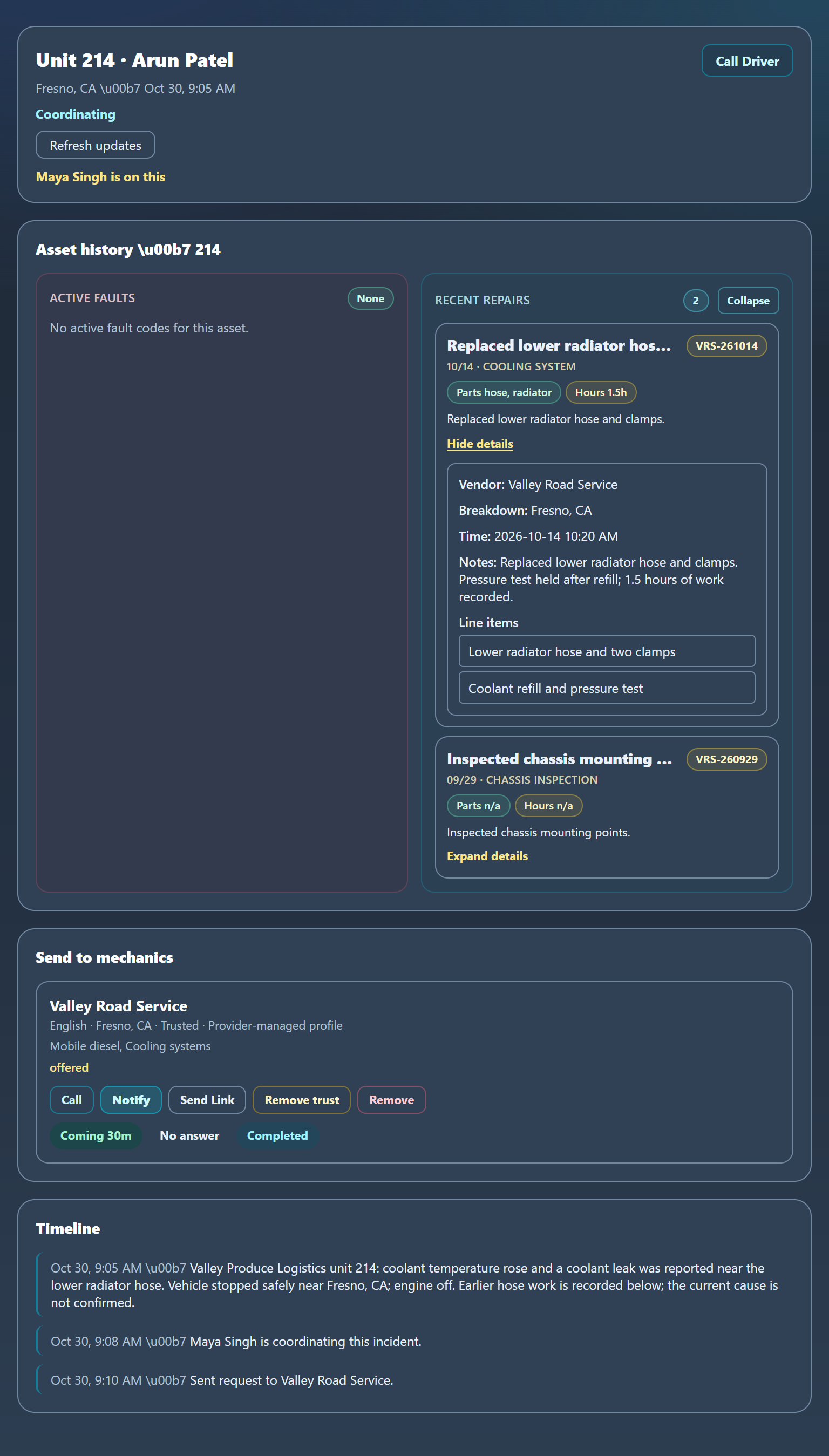
Coordinator incident viewSteel
Roadside incident with cooling-system history and carrier-connected mechanic request.
Open full screen ↗ · Sample records

Unit 214: earlier cooling-system work alongside the current incident and provider request.

Mechanic review and response

  1. 04

    Show the details before the mechanic accepts

    Before acceptance, the mechanic can review the issue, original incident media, and filtered recent repair descriptions. Historical structured prices are omitted, giving repair context for the decision without presenting prior invoice amounts as a quote.

  2. 05

    See who has accepted and when they expect to arrive

    Acceptance or decline, a recorded ETA, and subsequent progress updates stay with the incident. The coordinator uses those responses to arrange follow-up or contact another provider; a request alone does not confirm arrival.

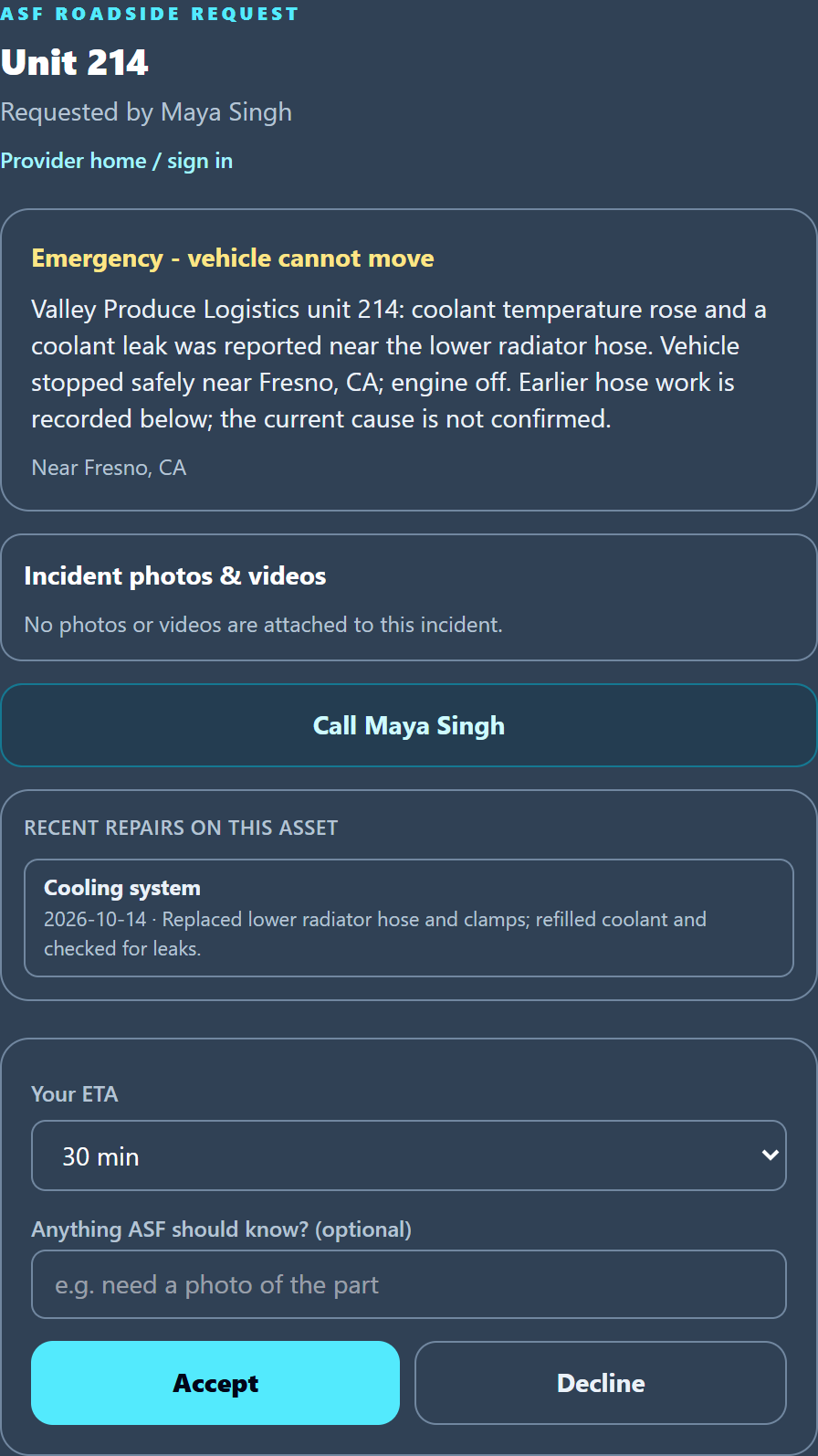
Before the mechanic acceptsSteel
External mechanic request with issue summary and recent repair descriptions before acceptance.
Open full screen ↗ · Sample records

The mechanic can read the issue and recent repair context before committing to the job.

The office arranges help. Availability and outcomes are not guaranteed; repair history is not a diagnosis.

Follow a roadside request, from driver report to mechanic response

One roadside request, four decisions

A truck needs help. The history comes with it.

A repair record may help accounts close out a bill today. Later, that same record can give a coordinator context for a mechanic request—without treating an earlier repair as a diagnosis of a new problem.

Illustrative sequence · Fictional unit 214 · Not application screens

01 / Driver reports

Start with what the driver actually noticed.

The coordinator needs enough context to decide what to ask next. An interpreted summary makes a report easier to review; it does not replace the driver's own words. Original voice and photos are optional supporting material.

The decisionWhat needs clarification before requesting help?

Report notes Fictional unit 214

Driver's words · illustrative voice transcript

“Coolant is leaking under the truck. I've made a safe stop.”

Interpreted summary

Driver reports a coolant leak and says the truck is stopped safely. Source of the leak is not confirmed.

Optional originals

Original voice report and driver photos, if supplied. No recording or photograph is reproduced in this example.

A report to review—not a mechanical diagnosis.

02 / Coordinator reviews

Look back at the same unit. Keep the connection open.

Recent repair descriptions can prompt a better question. An earlier radiator hose replacement is worth reading, but it cannot establish where today's coolant leak comes from. Ounkar brings recent same-unit repair context into the request; the coordinator and mechanic decide what it means for this job.

The decisionWhich recent records give useful context without implying a cause?

Repair history excerpt Same unit · 214
12 days earlier
Radiator hose replacementRepair description: upper radiator hose replaced; coolant refilled.
27 days earlier
Battery replacementRepair description: battery replaced after a starting complaint.

A question, not a conclusion

Could the earlier hose work be useful context? This is not an automatic match to the current leak.

Illustrative descriptions and relative dates. No diagnostic ranking.

03 / Mechanic considers

Give the mechanic context before asking for a yes.

The coordinator chooses a provider and shares the request. Before accepting, the mechanic can review the issue summary, supplied original media, selected recent repair descriptions, and coordinator contact information.

Structured historical charges are omitted from this shared history. That is not a promise that every private detail has been removed from descriptions or original media.

The decisionIs there enough information to accept—or should the mechanic contact the coordinator first?

Shared request outline Before acceptance
Issue summary
Reported coolant leak. Driver reports a safe stop. Cause unconfirmed.
Original media
Driver voice and photos, if supplied with the request.
Selected history
Unit 214 · earlier radiator hose replacement description.
Coordinator contact
Request coordinator's name and contact details accompany the request.

Structured historical charges omitted. Descriptions and media still need a privacy review.

04 / Coordinator follows through

A response makes the next decision clearer.

If the mechanic accepts and provides an ETA, the coordinator has a proposed arrival time to work with. If the mechanic declines, the coordinator can approach another provider. Neither response guarantees availability, arrival, a diagnosis, or a repair outcome.

The decisionConfirm the next step with this provider, or contact another?

Two possible replies Illustrative alternatives

If accepted · ETA provided

“Accepted. Estimated arrival: 45 minutes.”

The coordinator can follow up on the estimate. It is not a guaranteed arrival time.

Alternatively · declined

“Unable to take this request.”

The coordinator chooses whether to request help from another provider.

Separate possible paths—not consecutive events or a live provider response.

What is shared—and what still needs human judgment?